
Team Organization
The entire project is flexibly structured into two major teams, Atombot Hydrogen and Atombot Helium, based on the robot prototype each team works on. Within each team, multiple subteams can be dynamically formed to promote focus and efficiency and nurture team science. Each team has a team leader, who will oversee the research activities of the team and take the prime responsibility of reporting. Students are expected to work closely with their respective team members and, at the same time, collaborate organically with other teams. Students may move between teams and subteams as workload and individual interest dictates. Students at all levels, from first-year undergraduate students to graduate students, are welcome to apply to fill in the different roles of the project. Furthermore, recurring enrollment after one year is encouraged for the students to develop a deep understanding of the technology as well as leadership skills. As the students’ knowledge grows over time, leadership roles such as technical lead and entrepreneurial lead are available for experienced students.Electronics (4-8 Students)
Specific tasks: design, manufacture, and test the electronic components—relevant to locomotion, sensors, and communications—of the two robot systems. Preferred skills: PCB and circuit design (Altium, Eagle, etc.) and fabrication; electronics platform, microcontroller, and embedded systems (Arduino, Raspberry Pi, Nvidia Jetson, etc.); sensing technologies (UWB, proximity, accelerometer, gyrometer, etc.) and near-field communication technologies; programming with C/C++/Python.Mechanics and Manufacture (4-8 Students)
Specific tasks: design, manufacture, and test the mechanical components of the two robot systems. Preferred skills: CAD design (SolidWorks); fabrication skills (3D printing, laser cutter, milling machine, soldering, etc.).Algorithms and Software (2-4 Students)
Specific tasks: perform simulations of the two robot systems; develop control methods. Preferred skills: programming with C/C++/Python; experience with some robot simulation platforms; self-balancing algorithms.Robot Physics (2-4 Students)
Specific tasks: review the literature on collective behavior of robots and robophysics; collect data of the atombot swarm; study the dynamics and phase behavior of atom swarm (jamming, phase transitions, etc.). Preferred skills: statistical mechanics/thermodynamics; programming with C/C++/Python; liquid state physics.Entrepreneurship and Business Development (1-2 Students)
Specific tasks: explore the use case of swarm robots; construct a business plan; design and create a website; discover and interview potential customers. Preferred skills: oral and written presentations and communications; business leadership; web design.Faculty Sponsor
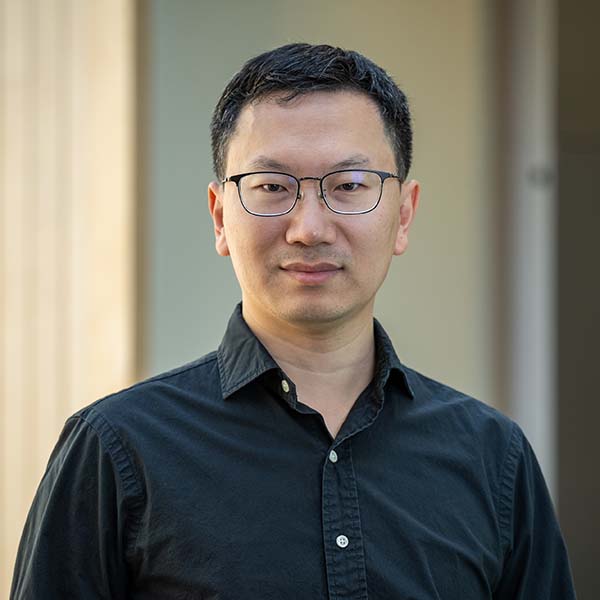
Y Z, PhD
Professor in the Department of Nuclear Engineering and Radiological Sciences, Department of Electrical Engineering and Computer Science, Department of Materials Science and Engineering, Department of Robotics, and Applied Physics Program.
The research in the Z Lab can be summarized into two words: Matter and Machine. In the realm of Matter, his group synergistically integrates statistical mechanics and molecular fluid mechanics theories, accelerated molecular simulations, understandable AI methods, and neutron scattering experiments to extend our understanding of rare events and long timescale phenomena in complex material systems. Particular emphasis is placed on the physics and chemistry of liquids, glasses, and complex fluids, especially at interfaces, under extreme conditions, or when driven away from equilibrium. Concurrently, on the Machine front, leveraging their expertise in materials and modeling, his group advances the development of soft robots and human-compatible machines, swarm robots and collective intelligence, and robots in extreme environments. These two research areas, spanning from fundamental to applied, serve as integral pillars in their overarching mission to foster a sustainable, resilient, and secure energy infrastructure.