
What is this project?
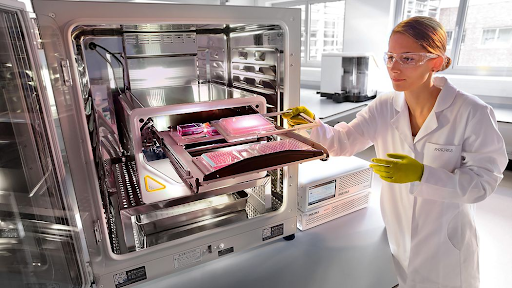
Help us continue to redesign our market leading live-cell research product, Incucyte. Students on the Sartorius team will refine the design of the miniaturized, precision Live-cell Research Platform, making it even more precise and getting the design market ready.
What am I going to do?
MDP projects push you to integrate interdisciplinary engineering knowledge and develop strategic problem-solving skills. On this project, students will continue the work of the 2025 Sartorius team, and make the Incucyte more precise and market ready.
- Design and build a ready for market prototype that that supports a standard Incucyte tray, provides transparent access for image equipment, and can be used to demonstrate precision temperature control
- Leverage industrial design direction to design and build a refined, ready for market device
- Tune the control system and evaluate the performance of the prototype against the requirements of the project, demonstrate extended precision control, returning to 90% of desired environment within 10 minutes of opening the incubator
- Complete precision control demonstration of all environmental parameters
- Work with Sartorius biology team to review and test the design in the lab!
- Tech Stack: SolidWorks, C, Python
Stretch Goal Opportunities Include:
- Work with the Sartorius team to market test the new device with focus groups/potential clients
Why does it matter?
The Incucyte product is a research tool that allows scientists to observe experimental progress, and perform real-time, live-cell imaging over long periods without disturbing cell development. Sustaining live cell cultures requires incredibly tight control of the environment over long periods of time (e.g., even tiny changes in temperature (0.2° C) could destroy an experiment). Other parameters, such as relative humidity, CO2 levels, airflow rates, etc. have similarly tight requirements.
The status quo design solution places the Incucyte tray within a large incubator designed to keep the cells in a stationary and controlled environment. This design has proven commercially popular amongst biologists. One of the challenges of this design is that it forces all parts of the equipment to fit within the space available in the incubator, thus limiting and complicating additions of functionality.
Students on this project will continue the work done by the 2025 MDP team to refine the prototype of the next generation of live-cell equipment, consisting of a much smaller incubator, able to hold the Incucyte tray and externalizing all other subsystems (imaging, temperature control, humidity control, etc.). The focus of this project will be on improving precision, and making a market ready version of the device.
This project will provide the basis for a whole new line of live-cell research products, accelerating the pace of scientific discovery, and improving Sartorius’ position in the marketplace.
Below are the skills needed for this project. Students with the following relevant skills and interests, regardless of major, are encouraged to apply! This is a team-based multidisciplinary project. Students on the team are not expected to have experience in all areas, but should be willing to learn and will be asked to perform a breadth of tasks throughout the two-semester project.
Hardware and Sensor Integration (2-3 students)
Specific Skills: Control system development, circuit design, sensor selection, evaluation, integration, and sensor design
Likely Majors: EE, CE, ECE, ROB, ME, AERO
Heat Transfer and Fluids Modeling (1 Students)
Specific Skills: Intermediate heat transfer and fluids modeling
Likely Majors: ChE, MSE
Mechanical Design and Systems Engineering (2-3 Students)
Specific Skills: Determining user needs, experimental design, testing and evaluation, integrating mechanical and electrical components, modeling heat transfer and other environmental variables. High fidelity prototyping. Voice of the customer surveys.
EECS 314 or equivalent is a strong plus
Likely Majors: ME, BME, AERO
Additional Desired Skills/Knowledge/Experience
Strong candidates will have familiarity or experience with some of the following, items and a positive attitude to learn what is necessary, as the project gets underway.
- Passion for the field of biotechnology
- Interest in developing control systems
- Hands-on, proactive approach to work
- Successful team-based experience in any context
- Practical mechanical system design skills: high fidelity prototype and design, 3D printing, sensor/hardware integration, basic controls, fast prototyping, CAD, machining, etc.
- Experience with Arduino, Raspberry PI, or similar
- Biolab experience, particularly live cell experience
- Design for manufacturing experience is a plus.
Recommended Coursework
If you have completed any of the following courses, please highlight them in your application:
- EECS 314: Electrical Circuits, Systems, and Applications
- EECS 460: Control Systems Analysis and Design
- EECS 461: Embedded Control Systems
- MECHENG 350: Design and Manufacturing II
- MECHENG 335: Heat Transfer
- MECHENG 420: Fluid Mechanics II
- MECHENG 461: Automatic Control
- AEROSP 470: Control of Aerospace Vehicles
Sponsor Mentor

John York
John is a UM computer engineering alumnus. John has supported several MDP projects in the past, mostly for software and machine learning. John has experience working with small startups as well as large global companies, both as a leader within the technology and product management teams.

Kyle Schutte
Kyle is a Sr. Mechanical Engineer that has been with Sartorius for 10+ years, working on all iterations of the Incucyte live-cell imaging system since the inception of the S-series platform in 2017. Kyle has spent the majority of his career in the life science industry, working at smaller companies and engaging with the end users of the instruments he works on. Currently, he is a mentor for an ongoing MDP project, and looking to continue to work with students in their pursuit of hands-on, project-based learning.
Executive Mentor
Tae Kang
Tae has been a part of the life science industry since 1999, holding roles as both an engineer and manager in various roles. He has contributed to the development of various life science microplate readers and instruments. Currently, Tae manages the engineering team for the Lab Products and Services division in North America.
Faculty Mentor
Peter Seiler
Associate Professor, Electrical Engineering and Computer Science
Peter works in the area of robust control theory, which focuses on the impact of model uncertainty on systems design. He is a contributor of the Robust Control Toolbox in MATLAB. He is currently developing theoretical and numerical algorithms to assess the robustness of systems on finite time horizons. He is also investigating the use of robust control techniques to better understand optimization algorithms and model-free reinforcement learning methods.
Project Meetings
During the winter 2026 semester, the Sartorius team will meet on North Campus on Fridays from 9 – 11 am in 4419 EECS.
Work Location
Most of the work will take place on campus in Ann Arbor, with opportunities to travel to Sartorius’ Ann Arbor office to access labs and equipment, and for occasional meetings and presentations with stakeholders. MDP will provide transportation.
Course Substitutions: CE MDE, BME PiP or CD, ChE Elective, EE MDE, CoE Honors, MECHENG 490, MECHENG 590, ROB Flex Tech
Citizenship Requirements: This project is open to all students. Note: International students on an F-1 visa will be required to declare part time CPT during Winter 2026 and Fall 2026 terms.
IP/NDA: Students will sign an IP and NDA agreement that is unique to Sartorius.
Summer Project Activities: Students with the right to work in the USA indefinitely without sponsorship will be guaranteed an interview for a 2026 internship. The interviews will take place before the end of March of 2026.